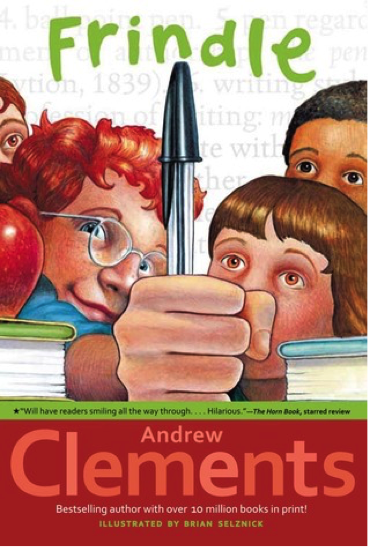
APA citation: Clements, A. (1996). Frindle. New York: Scholastic
Summary of the book: This relatable follows Nick through his adventure in creating a new word. His ingenuity in the creation and his adventure in creating the word to spread beyond just his friends- but to other students at the school. This is a fun story that would be engaging for students.
Retrieved from: https://cgbarbee.wordpress.com/2013/11/15/frindle/
Age Level or Grade level the book is appropriate: grades 4-8
Justification: CCSS.ELA-LITERACY.RL.4.6 standard would be used to teach this book. I would use it to teach the different points of views in books, first person, second person, and third person. I would use this as the second book in a lesson to learn points of view. Pairing this book with a book that has a different point of view would be an enjoyable way for students to see the difference in views.
Review: “Nicholas is a bright boy who likes to make trouble at school, creatively. When he decides to torment his fifth-grade English teacher, Mrs. Granger (who is just as smart as he is), by getting everyone in the class to replace the word “pen” with “frindle,” he unleashes a series of events that rapidly spins out of control. If there’s any justice in the world, Clements (Temple Cat, 1995, etc.) may have something of a classic on his hands. By turns amusing and adroit, this first novel is also utterly satisfying. The chess like sparring between the gifted Nicholas and his crafty teacher is enthralling, while Mrs. Granger is that rarest of the breed:a teacher the children fear and complain about for the school year, and love and respect forever after. With comically realistic black-and-white illustrations by Selznick (The Robot King, 1995, etc.), this is a captivating tale–one to press upon children, and one they’ll be passing among themselves. (Fiction. 8-12)”
Retrievedfrom https://www.kirkusreviews.com/book-reviews/andrew-clements/frindle/
Picture of the front cover:
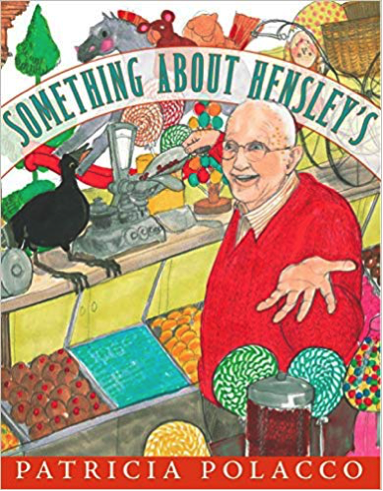
APA citation: Polacco, P. (2006). Something about Hensley’s. New York: Philomel Books.
Summary of the book: There’s something about Hensley’s! No matter what you need, that general store is sure to have it. It’s almost magical the way the manager, Old John, seems to know what the townsfolk need before they do! But then a new family moves to town.The youngest child, Molly, has asthma—but her mother doesn’t have money to treat her, or for anything else. But leave it to Old John to find a way to use Hensley’s to give the family exactly what it needs, even if it can’t be boxed or bagged.
A true—and truly moving—story about an unforgettable general store and about the extraordinary power one person’s acts of kindness can have on another.
Retrieved from https://www.amazon.com/Something-About-Hensleys-Patricia-Polacco/dp/0399245383
Age Level or Grade level the book is appropriate: Primary-3rd grade
Justification: I would use this book for the standard CCSS.ELA-LITERACY RL.4.3 I would use it to teach character traits, so that students could learn how to describe a character in depth. This book would be used as a read-aloud lesson, and I would demonstrate how using textual evidence from the book allows us to learn character traits. This is actually the book that I used for my first lesson in the classroom.
Review: “Hensley’s is not an ordinary store. No matter what a customer needs—even if he or she doesn’t know what it is—Old John, the owner, has it somewhere. When Molly andKate move to town with their mother, they wander in and are presented with the ideal candy. They visit often, and Kate confides that she can’t get a cat because of her sister’s allergies. Old John suspects there’s more to the story,and he’s proven right when Molly has an asthma attack, and Kate and Molly’s mother can’t pay the doctor’s bill. But Hensley’s always has what a customer needs, even a way to improve the family’s finances and the means for the girls to adopt a pet. Polacco’s story is sweet and comforting, and her trademark pen-and-marker illustrations capture the feeling of a general store still hanging on in middle America (Hensley’s actually exists). While in reality such a story may not end so perfectly, readers will be happy to see that the bubble that encloses Hensley’s does not burst. (Picture book. 5-8)”
Retrieved from https://www.kirkusreviews.com/book-reviews/patricia-polacco/something-about-hensleys/
Picture of the front cover:
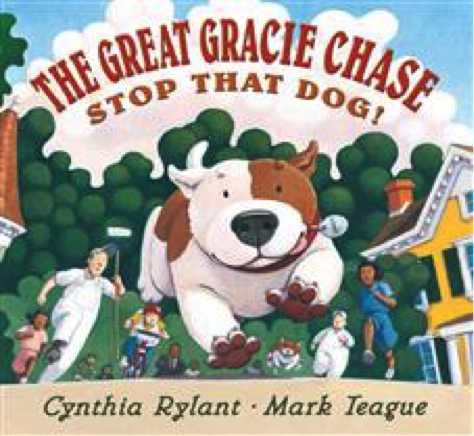
APA citation: Rylant, C. (2001). The great Gracie chase. New York: Blue Sky Press.
Summary of the book: WhenGracie is put outside for barking at the noisy painters, she decides to stretch her legs and take a walk, but when her owners and the painters begin to chase after her, Gracie decides to speed things up and soon the whole town is attempting to catch her.
Retrieved from https://www.amazon.com/Great-Gracie-Chase-Stop-that/dp/0590100416
Age Level or Grade level the book is appropriate: Primary- 3rd grade
Justification: I would use this book to teach CCSS.ELA-Literacy.RL.4.1 This book has a series of events that lead to the ending, so it would be a good to use for students to draw inferences from the text on what they think will happen next. This would be a great way to start a lesson on making inferences, because it is a lower level book, so it would fit most students comprehension skills in the 4th grade.
Review: “Gracie Rose, a charming brown-and-white puppy,loves a quiet house. She loves the kitty sleeping quietly on the windowsill.She sings to the fish when it’s lonely. She helps the bigger dog watch the house. For Gracie, the best home is a quiet one. But one day, the painters who come to paint her kitchen destroy the quiet. Not only are they noisy, but they put her out of the house when she barks at them. Gracie, who has always been a good dog, runs through an open gate and takes off. The whole town runs after her, gathering much as do the folks in “The Gingerbread Boy.” Only when everyone, including the painters, drops from exhaustion can Gracie return to her home and find peace and quiet. Unfortunately for Gracie Rose, the reader knows that the dreaded painters will come again. Rylant’s story seems deceptively simple, but its prose is beautifully phrased, conversational intone, and easy to read. Teague outdoes himself here; his oversized drawings are equal partners to Rylant’s words. They create narrative, movement, and fun on every page; Gracie often seems ready to leap from the page, as she becomes bigger than life. The small town is an idealized place where a multi ethnic community comes together good-humoredly to protect a fellow creature. Humans and animals express a variety of emotions, but Gracie’s face and body language as the painter puts her outside take the cake. The strong storyline in text and illustration makes this a fine read-aloud. Gracie Rose deserves a series! (Picturebook. 4-7)”
Retrieved from https://www.kirkusreviews.com/book-reviews/cynthia-rylant/the-great-gracie-chase/
Picture of the front cover:
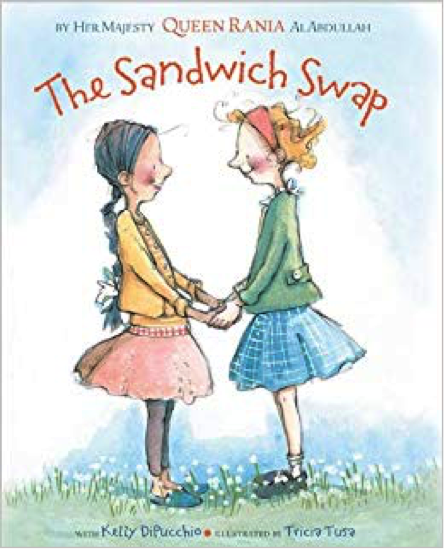
APA citation Rania, ., DiPucchio, K., & Tusa, T. (2012). The sandwich swap. New York: Scholastic.
Summary of the book: Lily and Salma are best friends. They like doing all the same things, and they always eat lunch together. Lily eats peanut butter and Salma eats hummus-but what’s that between friends? It turns out, a lot. Before they know it, a food fight breaks out. Can Lily and Salma put aside their differences? Or will a sandwich come between them?
The smallest things can pull us apart-until we learn that friendship is far more powerful than difference. In a glorious three-page gatefold at the end of the book, Salma, Lily, and all their classmates come together in the true spirit of tolerance and acceptance.
Age Level or Grade level the book is appropriate: Primary- 3rd grade
Justification: I would use this book with the CCSS.ELA-Literacy.RL.4.2. This book would be used to determine the theme of a story through drawing details from the text. The theme of this text is overcoming prejudice. It would be a great introduction to theme because the book level is lower, so it would be easy for students to comprehend what was going on.
Review: “Like all best friends, Lily and Salma do everything together: They draw pictures, play on the swings, jump rope and eat lunch together. But Lily eats a peanut-butter–and-jelly sandwich while Salma eats a hummus-and-pita sandwich. Each girl thinks the other’s looks yucky! When they say so, the friendship splits, school kids take sides and someone yells FOOD FIGHT! Salma and Lily feel ashamed, especially when they are called into the principal’s office. The next day they sample each other’s sandwiches and declare them delicious. They go to the principal’s office again, this time with an idea to share—a gatefold depicts a long picnic table overflowing with ethnic food and happy kids. Tusa’s whimsical illustrations spice up the story. Her large, vivacious drawings contribute character and comic touches, especially to the food fight, but there is one notable omission in this story of cultural understanding: Absent from the picnic table’s array of flags identifying ethnicities (which include Iceland, Greece and Mexico among others, in addition to the United States and Jordan) is the Israeli flag—a hugely sad missed opportunity.” (author’s note) (Picture book. 4-7)
Retrieved from https://www.kirkusreviews.com/book-reviews/rania-al-abdullah/the-sandwich-swap/
Picture of the front cover:
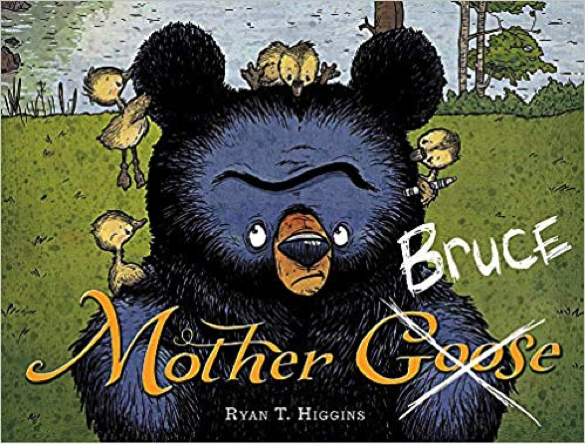
APA citation: Higgins, R. T. (2015). Mother Bruce (1st. ed.). Los Angeles ; New York: Disney*Hyperion.
Summary of the book: Bruce the bear likes to keep to himself. That, and eat eggs. But when his hard-boiled goose eggs turn out to be real, live goslings, he starts to lose his appetite. And even worse, the goslings are convinced he’s their mother. Bruce tries to get the geese to go south, but he can’t seem to rid himself of his new companions. What’s a bear to do?
Age Level or Grade level the book is appropriate: Primary- 2nd grade
Justification: CCSS.ELA-LITERACY.RL.4.9 This book would be a great use to have students learn how to compare and contrast the treatment of similar themes in traditional literature. This book is a spin off of Mother Goose. It would be a good book to introduce this topic and keep the attention of students.
Review: “Bruce is a stocky, black-and–dark-indigo bear with a scowling unibrow. He dislikes sunny days, rainy days, and cute little animals. He likes one thing: eggs, cooked into gourmet recipes that he finds on the Internet. He “collects” eggs fromMrs. Sparrow or Mrs. Goose—asking, hilariously, whether they’re “free-range organic”—but the pictures reveal the truth: he’s clearly stealing them. AsBruce brings home some goose eggs that unexpectedly hatch and imprint on him—“Bruce became the victim of mistaken identity”—wry text and marvelously detailed pictures juxtapose uproariously. Setting out to “get the ingredients”means wheeling a shopping cart into a river; “for some reason” he loses his appetite placing a pat of butter atop a live gosling’s head on his plate.Grumblingly, Bruce rears them from “annoying baby geese” through “stubborn teenage geese” (wearing headphones, naturally) into “boring adult geese.” Still they won’t leave him. Rather than migrating (by wing or by the giant slingshotBruce builds for the purpose), they don winter hats and coats. BefittingBruce’s personality, there’s no sappy change of heart, but this family is forever. Higgins’ softly fascinating textures, deft lines, savvy use of scale,and luminous landscapes (which evoke traditional romantic landscape painting,atmospheric in air and light) make for gorgeous art.Visually beautiful, clever,edgy, and very funny.” (Picture book. 3-6)
Retrieved from https://www.kirkusreviews.com/book-reviews/ryan-t-higgins/mother-bruce/
Picture of the front cover:
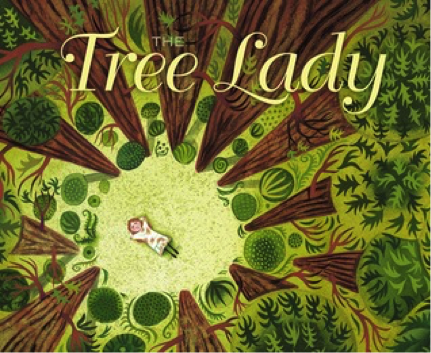
APA citation: Hopkins, H. J., & McElmurry, J. (2014). The tree lady: The true story of how one tree-loving woman changed a city forever. Toronto: CNIB.
Summary of the book: Unearth the true story of green-thumbed pioneer and activist Kate Sessions, who helped San Diego grow from a dry desert town into a lush, leafy city known for its gorgeous parks and gardens. Katherine Olivia Sessions never thought she’d live in a place without trees. After all,Kate grew up among the towering pines and redwoods of Northern California. But after becoming the first woman to graduate from the University of California with a degree in science, she took a job as a teacher far south in the dry desert town of San Diego. Where there were almost no trees.
Kate decided that San Diego needed trees more than anything else. So this trailblazing young woman singlehandedly started a massive movement that transformed the town into the green, garden-filled oasis it is today. Now, more than 100 years after Kate first arrived in San Diego,her gorgeous gardens and parks can be found all over the city.
Part fascinating biography, part inspirational story, this moving picture book about following your dreams, using your talents, and staying strong in the face of adversity is sure to resonate with readers young and old.
Retrieved from https://www.goodreads.com/book/show/17245740-the-tree-lady
Age Level or Grade level the book is appropriate: K-5th grade
Justification: I would use this book to teach the standard CCSS.ELA-Literacy.RI.4.3 This standard states that students should be able to explain events, procedures, ideas, or concepts in a scientific or technical text including what happened and why, based on specific information in the text. This book would allow students to learn about trees and the impact they have on the Earth. Students could tell what happened and why through using the specific information in the text. This would be a good book for me to use when modeling how to do this.
Review: “Hopkins respectfully profiles Kate Sessions, a pioneering horticulturalist who helped transform San Diego’s City Park from a barren waste into today’s lush, tree-filled Balboa Park.
Hopkins traces the effects of Kate’s childhood affinity for science and fascination with trees. Roaming the Northern California woods as a child and becoming the first woman to earn a science degree from the University of California in 1881, Kate turned her passion into work that transformed a community. After a brief teaching stint in San Diego, she became a gardener and worked out a nifty deal with the city: In exchange for leasing acreage for a plant nursery within City Park, she promised to plant 100 trees a year in the park and deliver additional hundreds for planting citywide. Sessions sourced seeds from species grown globally and coordinated tree-planting parties to beautify Balboa Park in time for the city’s 1915 Panama-California Exposition.Hopkins’ text presents Sessions’ achievements in simple language embodyingKate’s can-do spirit. “Most San Diegans didn’t think trees could ever grow there. But Kate did.” McElmurry’s gouache illustrations adopt a stylized,reductive approach. Foliage is rendered as green globes decorated with leaf forms; the bark of palms sports simple crosshatching. The artist nicely conveysKate’s life arc, from child among sequoias to elder on a tree-lined park path.
An appealing treatment of an accomplished woman’s life.(author’s note)” (Picture book/biography. 5-9)
Retrievedfrom https://www.kirkusreviews.com/book-reviews/h-joseph-hopkins/the-tree-lady/
Picture of the front cover:
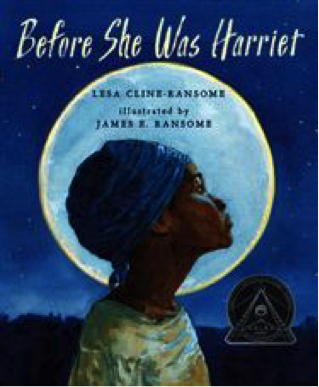
APA citation: Cline-Ransome, L., & Ransome, J. (2017). Before she was Harriet (First edition.). New York: Holiday House.
Summary of the book: A lush and lyrical biography of Harriet
Tubman, written in verse and illustrated by an award-winning artist.
We know her today as Harriet Tubman, but in her
lifetime she was called by many names. As General Tubman she was a Union spy.
As Moses she led hundreds to freedom on the Underground Railroad. As Minty she
was a slave whose spirit could not be broken. An evocative poem and opulent
watercolors come together to honor a woman of humble origins whose courage and
compassion make her larger than life.
Retrieved from https://www.goodreads.com/book/show/34474542-before-she-was-harriet
Age Level or Grade level the book is appropriate: Primary- 2nd grade
Justification: I would use the standard CCSS.ELA-Literacy.RI.4.5 This standard states that students should be able to describe the overall structure of the text. This story is in reverse chronological order and would fit this standard perfectly. I would use this book at the end of a lesson in a direct instruction plan. It would be used as my “we do” section of the lesson and be a good use to see if students understand the concept before being assessed on it.
Review: “A memorable, lyrical reverse-chronological walk through the life of an American icon.
In free verse, Cline-Ransome narrates the life of Harriet Tubman, starting and ending with a train ride Tubman takes as an old woman.“But before wrinkles formed / and her eyes failed,” Tubman could walk tirelessly under a starlit sky. Cline-Ransome then describes the array of roles Tubman played throughout her life, including suffragist, abolitionist, Union spy, and conductor on the Underground Railroad. By framing the story around a literal train ride, the Ransomes juxtapose the privilege of traveling by rail against Harriet’s earlier modes of travel, when she repeatedly ran for her life. Racism still abounds, however, for she rides in a segregated train. While the text introduces readers to the details of Tubman’s life, Ransome’s use of watercolor—such a striking departure from his oil illustrations in many of his other picture books—reveals Tubman’s humanity, determination, drive, and hope. Ransome’s lavishly detailed and expansive double-page spreads situate young readers in each time and place as the text takes them further into the past.
A picture book more than worthy of sharing the shelf with Alan Schroeder and Jerry Pinkney’s Minty (1996) and Carole Boston Weatherford and Kadir Nelson’s Moses (2006).” (Picturebook/biography. 5-8)
Retrieved from https://www.kirkusreviews.com/book-reviews/lesa-cline-ransome/before-she-was-harriet/
Picture of the front cover:
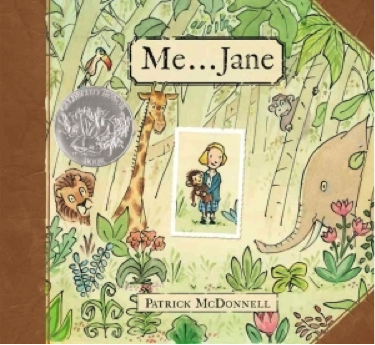
APA citation: McDonnell, P. (2011). Me– Jane. New York: Little, Brown and Co..
Summary of the book: In his characteristic heartwarming style,Patrick McDonnell tells the story of the young Jane Goodall and her special childhood toy chimpanzee named Jubilee. As the young Jane observes the natural world around her with wonder, she dreams of “a life living with and helping all animals,” until one day she finds that her dream has come true. With anecdotes taken directly from Jane Goodall’s autobiography,McDonnell makes this very true story accessible for the very young–and young at heart.
One of the world’s most inspiring women, Dr.Jane Goodall is a renowned humanitarian, conservationist, animal activist,environmentalist, and United Nations Messenger of Peace. In 1977 she founded the Jane Goodall Institute (JGI), a global nonprofit organization that empowers people to make a difference for all living things.
Retrieved from https://www.goodreads.com/book/show/9642662-me-jane
Age Level or Grade level the book is appropriate: Primary-2nd grade
Justification: I would use the standard CCSS.ELA-Literacy.RI.4.6 with this book. The standard states that students should be able to compare and contrast first hand and second hand accounts over the same event. This book is a second hand account and could be paired with an excerpt from Jane’s journal that would be a first hand account. This would be a good book because the information is not to difficult to understand, so the focus could be set on learning if it is first or second hand instead of comprehension.
Review: “Little Jane Goodall and Jubilee (her toy chimpanzee) ramble outside their English country home observing everyday animal miracles and dreaming of a life in Africa, “living with, / and helping, /all animals.” Readers familiar with the groundbreaking primatologist will love seeing her as a conventional, buttoned-up child, wearing a plaid skirt,classic bob and hair clip as she squats in a coop to watch a chicken drop an egg. McDonnell’s simple ink-and-watercolor illustrations appear as sunny,amorphous panels in ample white space. Purposeful black lines provide specificity with small suggestive strokes—a tiny apostrophic smile relaysJane’s complete contentment sprawled in grass. Opposite pages offer groupings of faint, intricate stamps that correspond with young Jane’s early outdoor experiences and engage readers with their fine details. The playful interplay among stamps, cartoonish drawings and real photographs of Jane reminds readers of a child’s hodgepodge journal—one like Jane’s, which appears as a double-page spread showing her animal studies, charts, games and doodles. Children will appreciate McDonnell’s original format and take heart that interests logged in their own diaries might turn into lifelong passions. Back matter includes apithy biography, additional photographs and a letter and drawing from Jane herself—children will thrill at the connection.” (Picturebook/biography. 2-10)
Retrieved from https://www.kirkusreviews.com/book-reviews/patrick-mcdonnell/mejane/
Picture of the front cover
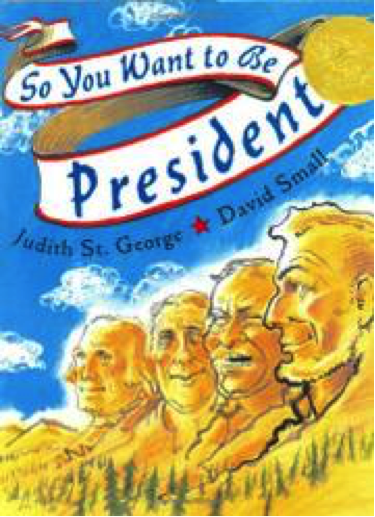
APA citation: St. George, J., & Small, D. (2004). So you want to be president? (Updated and rev. ed.). New York: Philomel Books.
Summary of the book: This new version of the Caldecott-winning classic by illustrator David Small and author Judith St. George is updated with current facts and new illustrations to include our forty-second president, George W.Bush. There are now three Georges in the catalog of presidential names, a Bush alongside the presidential family tree, and a new face on the end paper portraiture.
Hilariously illustrated by Small, this celebration by St. George shows us the foibles, quirks and humanity of forty-two men who have risen to one of the most powerful positions in the world.Perfect for this election year–and every year!
Retrieved from https://www.goodreads.com/book/show/96125.So_You_Want_to_Be_President_?from_search=true
Age Level or Grade level the book is appropriate: k-5th grade
Justification: I would use the standard CCSS.ELA-Literacy.RI.4.4 with this book. The book has domain-specific words and phrases that are in grade 4 subject area. It is a fun nonfiction book to use to teach this standard and I think it would be good use at the beginning of a lesson.
Review: Just in time for the presidential election, St. George (In the Line of Fire:Presidents Lives at Stake, 1999, etc.) uses the experiences of our 42presidents to counsel youngsters harboring that uniquely American desire—to be president. Reflecting on the “good things about being President and . . . bad things about being President . . .” she offers a pleasingly diverse slate of facts and figures for her readers’ consideration: age (the oldest—Reagan; the youngest—Teddy Roosevelt), size (the smallest—Madison—at 100 lbs., contrasting with Taft, at over 300), career choices (generals, lawyers, haberdashers, farmers),first names (six Jameses, four Johns, four Williams, two Georges, twoFranklins), education (nine presidents never went to college, while one—AndrewJohnson—“didn’t learn to write until after he was married”). At the close of this sometimes wry, sometimes sober survey (including impeachments, wars, and assassinations), St. George encourages: “If you want to be president—a good president—pattern yourself after the best . . . [those who] have asked more of themselves than they thought they could give . . . They [who] have had the courage, spirit, and will to do . . . [what’s] right.” Small’s (The Huckabuck Family, 1999, etc.) pitch-perfect caricatures, rendered in a mix of watercolor, ink, and pastel, expand on the personalities and support the narrative’s shifting moods. There’s a helpful key to every illustration and a presidential chronology from Washington to Clinton. Even a few “non-presidents”are featured: Pat Nixon and Henry Kissinger watch (with future President Ford)President Nixon bowl in the White House lanes, and there’s a wonderfully wry glimpse of two “also-ran’s”—Jesse Jackson and Geraldine Ferraro—excluded from an across-the-centuries presidential reception by a velvet rope. A superb,kid-centered survey and a perfect way to enliven the perennial class unit on the presidents. (Nonfiction. 7-12)
Retrieved from https://www.kirkusreviews.com/book-reviews/judith-st-george/so-you-want-to-be-president/
Picture of the front cover:
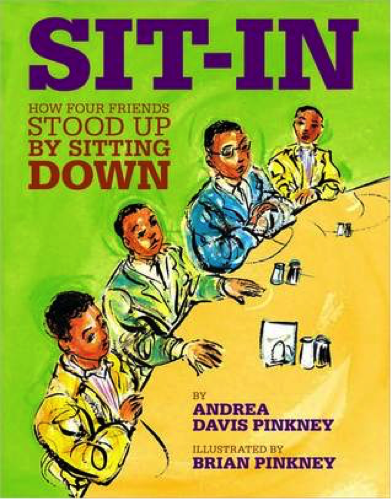
APA citation: Pinkney, A. D., & Pinkney, J. B. (2010). Sit-in: How four friends stood up by sitting down. New York: Little, Brown.
Summary of the book: This picture book is a celebration of the 50th anniversary of the momentous Woolworth’s lunch counter sit-in, when four college students staged a peaceful protest that became a defining moment in the struggle for racial equality and the growing civil rights movement.
Andrea Davis Pinkney uses poetic, powerful prose to tell the story of these four young men, who followed Dr. Martin Luther KingJr.’s words of peaceful protest and dared to sit at the “whites only”Woolworth’s lunch counter. Brian Pinkney embraces a new artistic style,creating expressive paintings filled with emotion that mirror the hope,strength, and determination that fueled the dreams of not only these four young men, but also countless others.
Retrieved from https://www.goodreads.com/book/show/7030777-sit-in
Age Level or Grade level the book is appropriate: K-5th grade
Justification: I would use the standard CCSS.ELA-Literacy.RI.4.2 with this book to model how we determine the main idea of a text through explaining how it is supported by key details. It would be a good introduction book to pair with a worksheet that has students fill out key details they find while reading, and use those details to summarize the text through explaining those details with textual evidence.
Review: “The latest collaboration by this husband-and-wife team (the Caldecott Honor book Duke Ellington: The Piano Prince and His Orchestra )recreates the renowned 1960 sit-in staged by four black college students at a Greensboro “whites only” lunch counter. The narrative incorporates a steady stream of food metaphors, noting that the students ignored the law’s “recipe”for segregation (“a bitter mix”) replacing it the “new brew” of integration.Unfortunately, this device is more trite than moving (“Their order was simple:A double dose of peace, with nonviolence on the side”) and, at times, can come across as glib. Brief quotations by Martin Luther King Jr. appear in large,blocky text, emphasizing his influence on the actions of this quartet as well as those who followed their lead, staging sit-ins across the South. Brian Pinkney’s sinuous watercolor and ink art conveys the solidity and determination of the activists as well as a building energy that grew out of their act of civil disobedience. A succinct civil rights time line and additional facts and suggested reading about the topic round out this account. Ages 6–up.” (Feb.)
Retrieved from https://www.publishersweekly.com/978-0-316-07016-4

 Grace's Literature Blog